

Gassensorer vil finde vej ind i konsumerprodukter
Yole Développement, der en af industriens førende analytikere af sensorindustrien, vurderer, at gassensorer i de kommende år vil blive integreret i mange konsumerprodukter (in english).
The latest analysis from Yole Développement (Yole) and dedicated to gas sensors technology and market trends estimates that the gas sensor market is currently growing, driven by HVAC and future consumer applications. This analysis, entitled 'Gas Sensor Technology & Market', announces a US$ 920 million market in 2021, with +7.3% CAGR during the 2014-2021 period.- An upside market of almost $65 million in 2021 is possible if gas sensors are widely adopted in consumers products, says Dr Benjamin Roussel, Activity Leader, Medical Technologies at Yole.
Consumer applications including wearables and smartphones are driving new gas sensors development to reduce cost, power consumption and size, especially with MEMS technologies.
According to Yole gas sensors are today part of the combo sensors family: not only considered as a product itself, gas sensors are more and more combined with other sensors and so increase the functionalities and value of the system…
The 'More than Moore' market research and strategy consulting company Yole, proposes today a clear understanding of gas sensor applications through an outstanding segmentation. Aim of this new report is to provide technical and economic requirements per market segment. Moreover, within this new report, Yole reviews several scenarios for the integration of gas sensors in smartphones.
Air quality is becoming a major concern, and therefore gas sensors are increasingly attracting interest. Gas sensing technologies are not new:
- Gas sensors embedded in gas detectors for defense and industrial safety applications form a highly regulated and mature market, explains Dr Eric Mounier, Senior Technology & Market Analyst, MEMS & Sensors at Yole.
- But the growing awareness of the air quality is creating new applications and opportunities.These include gas sensors in consumer products like home devices, wearables and smartphones, or for buildings and cars, including indoor/in-cabin air quality monitoring.
According to Yole’s team, there are numerous drivers that will contribute to the gas sensor market growth:
• Driven by better energy management, the building market will experience 13.6% CAGR for a total market estimated at US$237 million in 2021.
• The medical industry is looking for very high sensitivity for asthma attack sensors or oxygen sensors for breath control.
• Consumer applications such as wearables and smartphones are driving the development of new gas sensors to reduce cost, power consumption and size with MEMS technologies.
• Driven by the desire for better outdoor air quality control, the environmental market will grow at almost 19% CAGR.
• The transport market is driven by oxygen sensors and future depollution applications.
- The consumer market is very attractive as it can drive very large volumes depending on user case adoption, cost and technical maturity, says Dr Roussel. The smartphone industry has revolutionized the sensor industry as mobile applications today aggregate ever more sensors. Gas sensors could be the next to be integrated in smart phones and/or wearables. As Yole’s analysts believe that user cases are crucial for wide adoption of gas sensors in consumer products, they have built a list of potential applications and benchmarked them.
Yole’s gas market report describes in detail three different scenarios for the consumer application:
• Realistic scenario: for the next few years, Yole’s team foresees slow adoption of gas sensors by mobile manufacturers. Only Tier 2 and 3 smartphone manufacturers will embed gas sensors in mobiles.
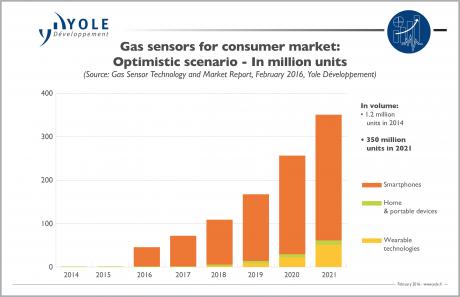
• Optimistic scenario: Yole assumes integration of gas sensors in a major smartphone model in 2016 and growing adoption for the next five years. This scenario is dependent on technical maturity and cost.
- At Yole, we think that there are still some required improvements: reducing the cost and form factor for optical-based solution, increasing the sensitivity for semiconductor-based solutions… are part of the challenges, says Dr Mounier from Yole.
• 'Rollercoaster' scenario: Yole simulates integration of gas sensors in a major smartphone model in 2016. But, one year later, the sensor will be removed by the company due to the absence of a clear user case. This case study is similar to the adoption and removal of the humidity sensor in the Samsung Galaxy S4.
Yole’s optimistic scenario estimates a market volume of 350 million units in 2021.
