

Banebrydende minikamera med 'øje' som et insekt
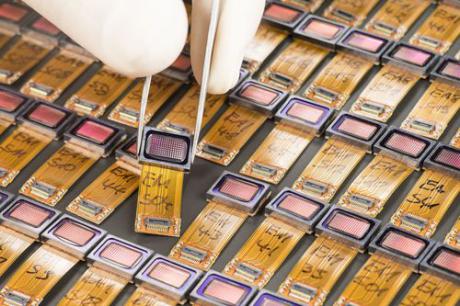
Fraunhofer forskere har udviklet en proces, der gør muligt at producere et minikamera med en tykkelse på kun 2 mm. Linsen består af 135 små mikrolinser placeret ved siden af hinanden og minder således om et insekt-øje (in english).
Fraunhofer researchers have developed a process enabling the production of a two millimeter flat camera. Similar to the eyes of insects, its lens is partitioned into 135 tiny facets. They are positioned close together, similar to the pieces of a mosaic. Each facet receives only a small section of its surroundings.The insect’s brain aggregates the many individual images of the facets to a whole picture. In the newly developed facetVISION camera, micro-lenses and aperture arrays take over these functions. Due to the offset of each lens to its associated aperture, each optical channel has an individual viewing direction and always depicts another area of the field of vision.
- With a camera thickness of only two millimeters, this technology, taken from nature’s model, will enable us to achieve a resolution of up to four megapixel. This is clearly a higher resolution compared to cameras in industrial applications – for example in robot technology or automobile production, explains Andreas Brückner, project manager at the Fraunhofer Institute for Applied Optics and Precision Engineering IOF in Jena.
The technology was developed together with scientists from the Fraunhofer Institute for Integrated Circuits IIS in Erlangen and was funded by the Fraunhofer-Zukunftsstiftung.
Economical production on wafers
The micro-lenses of the Fraunhofer researchers can get economically manufactured in large quantities – using processes similar to those applied in the semiconductor industry. Computer chips are mass-produced on wafers (large and thin semiconductor slices) and subsequently separated by sawing. Accordingly, thousands facetVISION camera lenses can be manufactured at the Fraunhofer IOF in parallel.
- The cameras are suitable in medical engineering, for instance – for optical sensors, which will be able to quickly and easily examine blood, says Brückner.
- In the printing industry, however, such cameras are needed to check the print image at high resolution while the machine is running.
Further applications include: Cameras in cars that help parking or in industrial robots that prevent collisions between man and machines.
An eye on smartphones
Compound eye technology is also suitable for integration into smartphones: today, their mini camera lens is normally five millimeters thick in order to show a satisfactorily sharp image of the surroundings.
The manufacturers of ultra-thin smarthones face the following challenge: since the camera is thicker than the smartphone housing, it sticks out of the smartphone’s back cover. The manufacturers call this the "camera-bump" – the unaesthetic 'camera bulge'.
The camera lenses for smartphones are, however, not made on wafers, but in injection molded plastic. In this procedure, hot liquid plastic is poured into the mold in a similar way as batter into a waffle iron. Robots then assemble the finished lenses into the smartphone camera.
- We would like to transfer the insect eye principle to this production technology. For example, it will be possible to place several smaller lenses next to each other in the smartphone camera. The combination of facet effect and proven injection molded lenses will enable resolutions of more than 10 megapixels in a camera requiring just a thickness of around three and a half millimeters, says Brückner.
