

Wirelaid pcb-teknologi kan løse stort problem i powerelektronik-systemer
Würth Elektronik tilbyder nu den såkaldte Wirelaid teknologi til high-power applikationer med partiel power management (in english).
The main challenge in modern high power circuit boards is combining high current and lots of control electronics into an extremely limited space. A solution which is being implemented more and more throughout the industry is the partial thick copper technology Wirelaid.
Alongside a reduction in cost, a reduced number of layers, improved heat dissipation and reduced system volume can be achieved using this new technology. Würth Elektronik designs to specific customer requirements for bespoke solutions.
- The partial thick copper technology has shown interesting results, when high current is required on some parts of the PCB and complex control electronics on the other parts, explains Stefan Rohde, who is responsible for Wirelaid and high power products at Würth Elektronik.
- For the design of a printed circuit board, there are several important aspects to take into account. Among others, current and maximum temperatures play a key role.
First things first: Modern components require higher currents if they are to be incorporated into a circuit board. These currents generate higher temperature on the circuit board and in the surrounding environment – a critical aspect for heat sensitive components. In addition to this, devices are getting smaller, but are simultaneously taking on ever more comprehensive tasks. This means less space for more complex control electronics. Modern circuit boards must therefore overcome all the different challenges: a compact PCB must safely carry high currents and as many fine pitch tracks as possible.
- When power and control electronics are combined on a board, large copper planes are no longer required as high current conductors. All that is required is that, where required, the boards are reinforced with copper wiring, explains Stefan Rohde further.
- With this technology, the designer can increase the copper cross section at certain points while maintaining a low layer count for the board. This reduces the volume and can simultaneously meet the current and heat dissipation requirements. To simplify, this technology saves some money because copper is expensive and less is used.
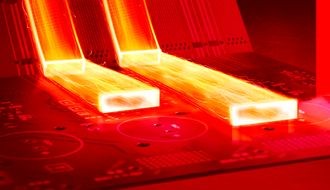
Wirelaid production sounds quite simple: silver plated copper wires are fixed onto a copper foil using welding points and then pressed using standard production processes together with the printed circuit board substrate. Done.
Würth Elektronik has created a Wirelaid design guide for customers which shows what spacing and dimensions should be used. The design guide also contains an overview of the current carrying ca-pacity of the different wire sizes.
- We are currently working with 1.4 mm and 0.8 mm thick copper wires that are embedded either on the outer or inner layers of the board, says Stefan Rohde. The partial thick copper technology has been used for drive tech-nology, engine electronics as well as AC and inverters.
- As with all complex designs, we offer our customers personal support in the development of the PCB," says the product manager.
