

PMIC til optiske målinger med høj følsomhed
Maxim's nye ultra low power PMIC baner vejen for at opbygge højfølsomme optiske målinger, der kan anvendes til opbygning af sensorløsninger til wearables og IoT (in english).
Designers of always-on wearable and internet of things (IoT) devices now have an easier way to extend battery runtime while shrinking form factor with the latest tiny, highly integrated power-management IC (PMIC) from Maxim Integrated Products.The ultra-low-power MAX20345 integrates a lithium charger and debuts a unique architecture that optimizes the sensitivity of optical measurements for wearable fitness and health applications.
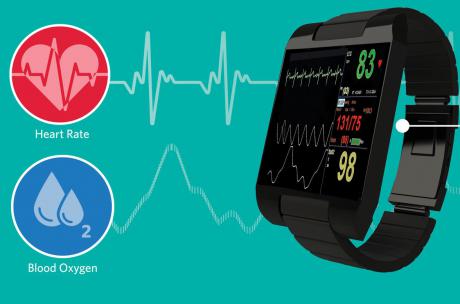
In wearables, optical-sensing accuracy is impacted by a variety of biological factors unique to the user. Designers have been striving to increase the sensitivity of optical systems, in particular the signal-to-noise ratio (SNR), to cover a broader spectrum of use cases.
Traditional low-quiescent-current regulators favored in wearable applications come with tradeoffs that degrade SNR on the wrist, such as high-amplitude ripple, low-frequency ripple and long-settling times.
Some designers have even turned to high-quiescent-current alternatives to overcome these drawbacks, but they must deal with increased power consumption, which reduces battery runtime or requires a larger battery. The MAX20345 features a first-of-its-kind buck-boost regulator based on an innovative architecture that's optimized for highly accurate heart-rate, blood-oxygen (SpO2) and other optical measurements.
The regulator delivers the desired low-quiescent-current performance without the drawbacks that degrade SNR and, as a result, can increase performance by up to 7dB (depending on measurement conditions).
The MAX20345 is also the latest in a line of ultra-low-power PMICs for small wearables and IoT devices that help raise efficiency without sacrificing battery runtime. To meet these needs, the MAX20345 integrates a lithium-ion battery charger; six voltage regulators, each with ultra-low quiescent current; three nanoPower bucks (900nA typical) and three LDO regulators with ultra-low quiescent current (as low as 550nA typical).
Two load switches allow disconnecting of system peripherals to minimize battery drain. Both the buck-boost and the bucks support dynamic voltage scaling (DVS), providing additional power-saving opportunities when lower voltages can be deployed under favorable conditions. The MAX20345 is available in a 56-bump, 0.4mm pitch, 3.37mm x 3.05mm wafer-level package (WLP).
