

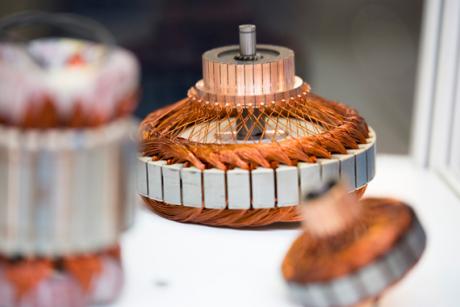
Ny spoleviklingsteknologi booster motoreffektiviteten
En ny spoleviklingsteknologi kan på en gang forøge motoreffektiviteten og power-factor værdien og kan udføres med overraskende kosteffektiv metode (in english).
Motor manufacturers are in a race to switch to more energy-efficient technologies to help countries reduce greenhouse gas emissions, as part of a global strategy to combat climate change. While many motor makers look to substitute more iron or copper in their induction motor product lines, or switch to other motor technologies, a U.S.-based company has developed a new stator winding topology that delivers more power while reducing energy intake.
Revolution Motor Industries, LLC (RMI), a small but savvy company based in St.Petersburg, Florida, has introduced a new winding technique that improves a three-phase induction motor's efficiency by one IE class. The technology, tested at 1.5 kw, 37 kw and 225 kw by Advanced Energy - one of America's premier electrical motor test labs - has delivered results that illustrate RMI's efficiency improvements over a wide range of application loads. The auxiliary winding uses smaller capacitors to improve the power factor without impacting motor efficiency.
- This new method will allow someone to go from an IE1 to an IE2 level, in a very cost-effective way, merely through winding, and then from an IE2 to an IE3. We are currently rewinding a number of 3.7 kw IE3 motors to acheive IE4 performance, which is where many companies in Europe are now moving in terms of AC induction motor efficiency, explains Dan Jones, the acting chief engineer for RMI and an electric motor designer with over 50 years of experience at a number of organizations.
- You don't need magnets, all you need is a winding change to achieve higher motor efficiency performance that will be required by various regulatory agencies as our industry tries to become more energy-efficient.
Benefits shared across multiple industries
In Europe and elsewhere, electric motors account for about two thirds of industrial power consumption and about 45% of global power usage. That means almost half of all power plants worldwide produce electricity for the sole purpose of running motors, and that any gains in efficiency have a large impact on comsumption. This is where RMI's technology can play a major role at reducing carbon dioxide emissions.
- This new winding technology could benefit any industry that uses AC induction motors. Heating, ventilating, air conditioning, water pumping for many waterworks that we have around the world. It could be used in fans that send both hot and cold energy down the ducts that we use for heating and cooling off buildings. The number of applications are very numerous, Jones says.
