

Universel kommunikationschip til smart meters
LAPIS Semiconductor's nye s universielle sub-GHz wireless LSI sigter mod adoption i smart meters og trådløse netværk over hele kloden (in english).
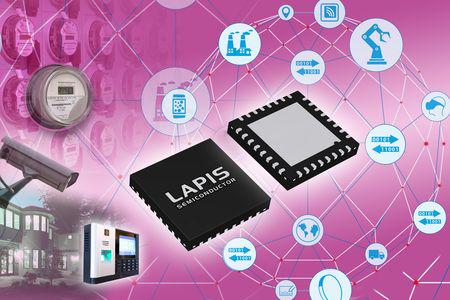
ROHM Group company LAPIS Semiconductor recently announced the availability of a sub-GHz wireless communication LSI optimized for applications requiring low power consumption over relatively long distances, such as smart-agriculture, gas/fire alarms, smart meters, and home/building security systems.In recent years the need to increase energy efficiency in order to mitigate global warming has become a moral and social imperative in all areas. As a result, from 2015 the use of smart meters have increased dramatically throughout Japan, the Wireless M-bus system was launched in Europe, and in China smart meters utilizing different systems were installed.
At the same time there is a movement to collect and manage data using wireless networks not only to optimize AC and lighting in offices and buildings and for crime and disaster prevention, but also to improve productivity and yield in primary industries such as agriculture.
LAPIS Semiconductor's new sub-GHz wireless LSI, which delivers high performance communication with low power consumption, is expected to see wide adoption in smart meters and wireless networks around the world. The ML7345 covers a wide range of sub-GHz frequencies (160MHz to 960MHz), providing universal compatibility.
Improving high-frequency amplifiers makes it possible to achieve class-leading wireless performance and environmental stability (more than 3x the transmission power temperature resistance), simplifying wireless network configuration (i.e. of smart meters) while improving reliability (e.g. reducing the number of relays).
In addition, a high-speed radio wave check function that performs receiver startup in a short period of time, combined with significantly reduced sleep current during standby (which accounts for the majority of communication time), decreases average current by 48% compared with conventional products, leading to lower system power consumption and longer battery life. And going forward, LAPIS Semiconductor will continue to simplify wireless device development that contributes to a smarter society.
