

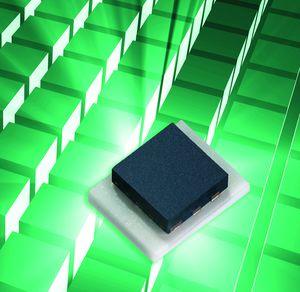
RFID device med wired I2C interface
Murata tilføjer nu et wired I2C interface til firmaets populære MAGICSTRAP RFID devices, hvilket åbner for en række ny applikationsområder (in english).
Murata announces that it has commenced mass production of the LXMS2HACNF-165 RFID device that features a wired I2C interface. Conforming to the RFID standards ISO/IEC 18000-6C, EPC global C1G2 and operating in the 900 MHz frequency band, this device is the latest addition to the surface mount MAGICSTRAP RFID family of devices.The addition of an I2C interface to the UHF RFID device means that the data of an IC mounted on the customer’s equipment and connected to it can be read using an UHF RFID-Reader/Writer. Likewise the data in the RFID device can be read by an IC.
Using an I2C MAGICSTRAP device makes it possible to achieve lower power consumption compared to other RF-technologies since power necessary for the communication is supplied by the reader/writer. Access to the RFID device is even possible when the power of the device equipped with the MAGICSTRAP is turned off. In addition, with the I2C MAGICSTRAP a wireless interface can be implemented at a lower cost than Bluetooth, Wi-Fi, and ZigBee as use of UHF RFID does not require certification on tag side.
The I2C interface extends the possible applications far beyond the use of previous MAGICSTRAP RFID tags which have been in the areas of process management, commodity management or traceability.
Potential applications for this new RFID device include management of memory settings of consumer appliances prior to shipping. For example, the settings of equipment can be changed even when it is packaged in a carton box immediately before shipment.
Other examples are is holding appliance error log data or recording environmental data such as temperature changes in food service supply chain logistics applications. Grace to the supply of the necessary power by the reader/writer, data can be retrieved from the MAGICSTRAP even when the equipment is malfunctioning or switched off.
RFID devices are used for exchanging information via near-field wireless communications, using electromagnetic fields, from an IC tag embedded with ID and other data. Using this technology, information can be stored in a small component and read in a distant location.
Compared with barcodes, RFID has the advantages of a much larger read-range, multiple tags can be read simultaneously, and information can be rewritten. RFID tags are already being used for inventory management in the distribution industry and management of work in process in the plant. In recent years, RFID has been used for non-contact IC cards such as prepaid transport IC cards of railways and electronic money, and the devices have significantly contributed to improving the convenience of everyday life.
