

Nyt banebrydende værktøj kan måle Bluetooth LE energiforbrug i IoT-devices
EEMBC har netop frigivet en industri-standard benchmark, der for første gang gør det muligt at lave en præcis evaluering af energieffektiviteten i microcontrollere og radiomoduler i IoT-endepunkter (in english).
EEMBC, the industry-consortium setting the real-world standards for valuable and practical application-specific benchmarks, has announced the availability of EEMBC IoTMark-BLE, a benchmark and analysis tool that measures the energy efficiency of microcontrollers and Bluetooth radios used in IoT edge-node devices (end points).Battery life is often a critical factor in the development of these end-node devices, especially
when they are difficult or inconvenient to access. While many microcontrollers are already
designed for ultra-low power, a big portion of the energy budget in an IoT application must be
allocated for transmitting and receiving data. As a result, whether the radio function is integrated into the microcontroller or added as a separate module, its energy consumption is often the dominant factor and can vary considerably between competing devices.
- The IoTMark-BLE provides IoT system developers with the means to select optimal
microcontroller and wireless solutions for their application by going beyond the limited datasheet specifications that tell only part of the story, says Brent Wilson, co-chair of the EEMBC IoTConnect working group and director of applications engineering at Silicon Laboratories.
- IoTMark-BLE measures the energy used by the full subsystem including the MCU, the radio,
and the protocol stack, while they perform relevant real-world tasks. Each part of the system
impacts energy efficiency, so evaluating the whole radio system provides the most realistic
evaluation of its battery life.
The IoTMark-BLE is the first of a suite of benchmarks that the EEMBC IoT-Connect Working
Group will deliver. Although the IoTMark-BLE targets IoT devices utilizing Bluetooth for
communication, the benchmark runs on a flexible, IoT-Connect benchmark framework that
EEMBC developed to accommodate additional benchmarks targeting other communication
protocols, including Wi-Fi, 6LoWPAN, and LPWAN. The Consortium is working to produce a
suite of benchmarks that allow comparisons between microcontrollers, radios, and modules as
well as between competing communication protocols.
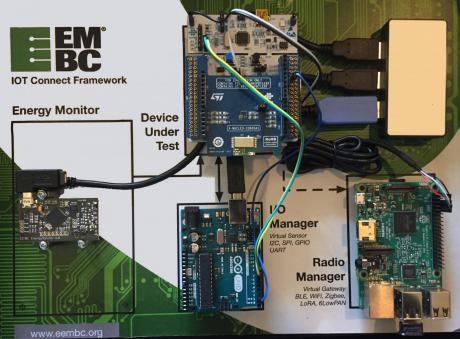
The key components of this flexible IoTConnect framework include
1) an EnergyMonitor to measure energy;
2) a radio manager, to coordinate the communication with the device under test (DUT);
3) an IO Manager to synchronize activities and to simulate a sensor input on the DUT’s I2C or serial peripheral interface (SPI).
- Bluetooth Low Energy (BLE) is a popular technology for many IoT edge-node applications,
such as health monitors, home automation devices, and wearable devices. Each application can
vary a range of parameters including payload size, frequency of payload transmission, and
transmit power. So EEMBC members had to agree on the specific set of tests and
measurements to cover a wide cross section of these applications, says Mark Wallis, co-chair of
the EEMBC IoT working group and system architect at STMicroelectronics.
- With IoTMark-BLE and the IoT-Connect framework, we’ve made it as easy as possible for developers to select the parameters and functions to ensure equitable comparisons while providing valuable insight beyond datasheet specifications.
- The IoT-Connect benchmark framework, which supports IoTMark-BLE, has the flexibility to
accommodate various communication protocols, and is also sufficiently portable to work with
any vendor’s microcontroller and radio-module products. We also designed the framework to
work with our other present and future benchmarks, including IoT-Secure and ULPBench, says
Peter Torelli, EEMBC director of technology.
- As always, the EEMBC benchmarks make customers’ AND semiconductor manufacturers’ jobs easier by encouraging the use of industrystandard benchmark results to inform their decisions, rather than having to demystify unsubstantiated claims from competitors.
All interested parties are welcome to join this working group to help define future profiles of this IoT benchmark, ensuring the maximum coverage and relevance for IoT communication
protocols and end-user scenarios.
Current working group members include Ambiq Micro, Analog Devices, ARM, Cypress
Semiconductor, Dialog Semiconductor, Flex, Imagination Technologies, Intel, Microchip, Nordic
Semiconductor, NXP, Renesas, Silicon Labs, STMicroelectronics, Synopsys, and Texas
Instruments.
http://www.eembc.org
