

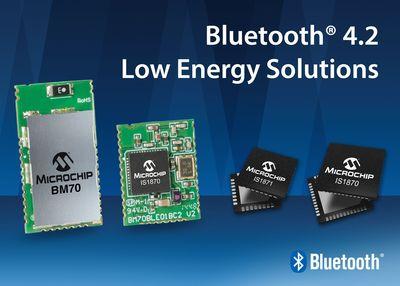
Microchip annoncerer ny generation af Bluetooth Low Energy løsninger
Microchip er klar med komplet program af Bluetooth 4.2-compliant chips, moduler og software (in english)
Microchip announces its next-generation Bluetooth Low Energy (LE) solutions. Qualified to the latest Bluetooth 4.2 standard, the IS1870 and IS1871 Bluetooth LE RF ICs, and the BM70 module, expand Microchip’s existing Bluetooth portfolio and carry worldwide regulatory and Bluetooth Special Interest Group (SIG) certifications. These new offerings are ideal for Internet of Things and Bluetooth Beacon applications, making it easy for designers to take advantage of the low power consumption and simplicity of Bluetooth LE connectivity.Microchip’s new Bluetooth LE devices include an integrated, certified Bluetooth 4.2 firmware stack. Developers can expect up to 2.5 times faster data transfer speeds and greater connection security, with government-grade (FIPS-based) secure connection support. Data is sent and received over the Bluetooth link using Transparent UART mode, making it easy to integrate with any processor or the hundreds of Microchip’s PIC microcontrollers that have a UART interface. The module also supports standalone 'hostless' operation for beacon applications.
The optimised power profile of these new devices minimises current consumption for extended battery life, whilst compact form factors down to 4x4 mm for the RF ICs and 15x12 mm for the module reduce board space. The module options include RF regulatory certifications, or non-certified (unshielded/antenna-less) modules for smaller and more remote antenna designs that will undergo end-product emission certifications.
Microchip’s Bluetooth LE modules include all of the hardware, software and certifications that designers need. Developers can leverage Microchip’s Bluetooth Qualified Design ID (QDID) to easily list their products with the Bluetooth SIG. Embedded Bluetooth stack profiles include GAP, GATT, ATT, SMP and L2CAP, as well as proprietary services for Transparent UART. All modules are configurable using Microchip’s Windows OS-based tools.
Microchip also announces the BM70 Bluetooth Low Energy PICtail/PICtail Plus daughter board. This new tool enables code development via USB interface to a PC, or by connecting to Microchip’s existing microcontroller development boards, such as the Explorer 16, PIC18 Explorer and PIC32 I/O Expansion Board.
The IS1870 Bluetooth LE RF IC is available in a 6x6 mm, 48-pin QFN package, whilst the IS1871 is expected to be available in November, in a 4x4 mm, 32-pin QFN package. The 30-pin BM70 Bluetooth LE modules are available with or without built-in PCB antennas,
http://www.microchip.com/Bluetooth-102015a
