

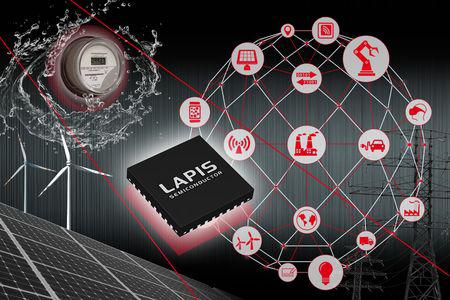
Dual-mode LPWA-chip understøtter både Sigfox og IEEE802.15.4k
LAPIS Semiconductor er klar med industriens første dual-mode LPWA (Low Power Wide Area) chips, der understøtter såvel Sigfox som IEEE802.15.4k standarderne (in english).
ROHM Group company LAPIS Semiconductor has recently announced the availability of an RF LSI optimized for LPWA (Low Power Wide Area), which is expected to usher in a new area of wireless IoT communication.The ML7404 is the first wireless communication LSI in the industry to feature LPWA dual-mode functionality, supporting both the Sigfox standard (subscription-based LPWA using unlicensed sub-GHz), which has been adopted in more than 30 countries and expanding in metropolitan areas including Japan, and the international protocol IEEE802.15.4K that is extremely robust against interference from the same system and has the capacity to cover more terminals under one network. This dual-mode capability enables use in a wide range of applications/specifications.
The 802.15.4k standard defined by IEEE is characterized by DSSS based on orthogonal spreading codes and features high interference tolerance from the same system compared with other spread spectrum communication methods. Plus it can accommodate more terminals under the same network. This protocol utilizes the high reliability sub-GHz band that does not require a license
Communication modules containing this device will be released from partner companies to simplify the development of LPWA-compatible devices that contribute increased IoT adoption. In addition, the protocol stack for IEEE802.15.4k will be provided as open-source from our partner stack vendors.
In recent years, LPWA using the sub-GHz band (which is not subject to RF licensing) is attracting attention for IoT applications. However, because the specific communication protocol varies from one country/region to the next, as of yet no method has been standardized from among the diverse array of IoT networks currently in use.
LAPIS semiconductor has previously released wireless communication LSIs for sub-GHz specified low power radio base stations ahead of the competition, helping to achieve a smarter world through IoT. This time we developed an LPWA device that supports multiple methods, facilitating the early launch of IoT networks and the effective spread of applications and services.
The new LSI will be shown in Europe at the EUW in Amsterdam beginning of October. European Utility Week is the premier innovation and information platform connecting the smart utility community. The fair is focusing on grid optimisation, renewables, energy storage, smart metering, smart cities, smart homes as well as intelligent buildings, data management and IoT.
Recommended applications includes gas and water meters, sensor networks, building health monitoring, smart agriculture, security systems, and other industrial applications requiring long-distance wireless communication.
