

Chokeless high-speed CAN transceivere med særdeles gode EMC-egenskaber
Texas Instruments lancerer to nye familier af CAN transceiver, der kan honorere alle de strengeste EMC-krav i automobilindustrien (in english).
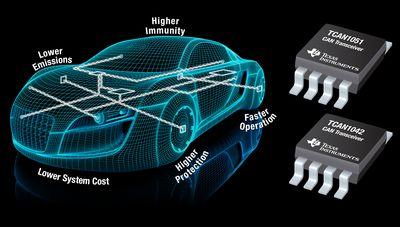
Texas Instruments (TI) has introduced two families of controller area network (CAN) transceivers that meet all industry requirements for electromagnetic compatibility (EMC) from U.S. and European automotive manufacturers.Delivering high bus-fault protection, fast CAN flexible data rate (FD) speeds and the industry’s shortest loop delay, the TCAN1042 and TCAN1051 CAN transceiver families provide the industry’s best combination of protection and high performance for a variety of automotive and industrial applications.
The 16 Automotive Electronics Council (AEC) Q100-qualified CAN transceivere meet EMC requirements for automobile manufacturers in the United States (Society of Automotive Engineers [SAE] J2962) and Europe (Ingenieurbüro für Industrielle Elektrotechnik [IBEE]-Zwickau).
The eight industrial devices meet the requirements of the Comité International Spécial des Perturbations Radioélectriques (CISPR) 22, International Electrotechnical Commission (IEC) 61000-4-6 up to 10 V, IEC 61000-4-4 Criteria A to ±4 kV, and IEC 61000-4-3 from 80 MHz to 2.7 GHz up to 100 V/meter.
The devices eliminate the need for an external noise-suppressant common-mode choke component, thereby reducing bill-of-materials cost and space in automotive and industrial designs.
They provide high bus-fault protection up to 70 V exceeds 12-, 24- and 48-V battery requirements, in addition to protecting against 24-V DC industrial power supplies. This protects CAN bus pins against short-to-DC voltages. ESD protection up to ±15 kV eliminates the need for external transient voltage suppression (TVS) diodes, saving board space and cost.
A fast CAN FD speed of up to 5 Mbps is supported, tha increases the communication speed and data-transfer capability between electronic control units and nodes on the CAN network.
The industry’s shortest loop delay of 175 ns enables more margin in the system design, longer networks and more nodes on the CAN bus.
Engineers can quickly and easily evaluate the performance of the TCAN1042 and TCAN1051 families with an evaluation module (EVM).
