

Store perspektiver med OLEDs uden farvefilter
Fraunhofer-forskere arbejder med teknologier, der kan bane vejen for OLED-displays helt uden farvefilter (in english)
OLED (Organic Light Emitting Diode) displays emit light themselves, and unlike the ordinary LCD (Liquid Crystal Display) screens of today, they work without background lighting. Yet the OLED technology is still in its infancy stages. Beside the minimal lifespan, up to now the extremely high acquisition costs are impeding a widespread breakthrough.
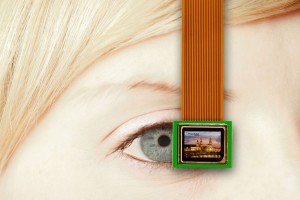
Producing organic light diodes is still very expensive. This is why you still cannot purchase large-scale OLED television screens currently. Right now, the technology is being used primarily for very small screen sizes of just a few square centimeters. Examples include the ViewFinder on digital cameras or – even smaller – on cellphone beamers and data glasses, explains Rigo Herold of the Fraunhofer Research Institution for Organics, Materials and Electronic Devices COMEDD.
Together with his colleagues, he is researching new production methods for OLED microdisplays with subpixels applied directly onto microdisplays. The researchers recently achieved an important breakthrough in this area: Together with VON ARDENNE Anlagentechnik GmbH they are developing a technology for producing mini-OLED screens without color filters.
That makes the production process not only cheaper, but even improves the luminosity of the microdisplays. Until now, the color filter suppressed the self-radiance of the OLED, so that only about 20 percent of the emitted light could be used. Two negative effects from the filter sheet being used are responsible for this: First, it suppresses two of the three color ranges of an OLED subpixel; second, as an additional layer applied over the OLED, it automatically dims the generated light.
In order to circumvent the use of the color filter, the red, green and blue subpixels – which are integral to the depiction of a color image – must be loaded onto the OLED directly. That was previously impossible.
- The subpixels in the tiny display are typically about 8 square micrometers in size. However, conventional technology only allowed for the processing of units greater than 50 square micrometers, says Herold, illustrating the challenge to be mastered.
In order to resolve this set of problems, scientists employed a special technology made by VON ARDENNE, their partner company. This technology facilitates the targeted vaporization of organic layers locally, under heat. In this manner, surfaces can be processed that are smaller than 10 square micrometers.
- In order to use the technology for OLED microdisplays, we redesigned the entire manufacturing process. It is therefore possible to load the red, green and blue color pixels directly. The use of the color filter is no longer necessary and it is possible to use 100 percent of the light emitted, says Herold.
Smartphones hold up longer
Still, the OLED not only shine brighter, the new production process is also less expensive. Color filters are very expensive to produce. Depending on the application, they have to be custom-designed, consist of suitable materials and be mounted properly. If the filter shifts, for instance, that could have a negative impact on the image quality.
- Ultimately, the consumer benefits as well: We all know that our mobile devices, like smartphones and digital cameras, consume a lot of energy each day. The less is used for the color presentation of the displays, the longer our batteries will last for telephone calls, surfing or taking pictures, Herold concludes.
