

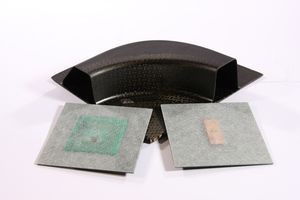
RFID tags kan nu indlejres i fiber-kompositter
Forskere på Fraunhofer institut har fundet nye måder at indlejre antenner i fiber-kompositter, hvilket åbner for helt nye applikationsområder (in english).
Researchers at the Fraunhofer Institute for Integrated Circuits IIS in Nuremburg have developed an RFID transponder whose antenna works reliably on fiber composites.
Components such as glass or carbon fibers are both lightweight and robust, and are thus used increasingly in airplane and vehicle production. However, these fibers have a particularly strong influence on frequencies. Until now, their exact behavior with regard to RFID has not been well known on the wireless system, and this is why production steps are still documented with a pencil and paper.
- We took a close look at the frequencies relevant to RFID technology: 125 kHz (LF: low frequency), 13.56 MHz (HF: high frequency), and 868 MHz (UHF: ultra high frequency). We measured the extent to which glass and carbon fibers affect the reliability of the trans- ponder, says Tobias Dräger, an engineer, in describing the work of the IIS team.
The result: while LF, HF, and UHF work well with glass fibers, they showed weaknesses with carbon fibers. The high frequencies in particular compromised the performance of the RFID chip significantly.
- Carbon fibers are, similarly to metal, conductive. As a result, they dampen radio signals considerably– especially at 868 MHz, says Dräger’s colleague Dr. Iker Mayordomo.
But thanks to their relatively large range of up to 15 meters, UHF frequencies are very well suited to applications in logistics and production. In the past, if RFID was used with incompatible materials such as metals, a very expensive transponder was required to reach this level of performance.
- The antennas and transponders required make these customized systems very large. At the same time, integrating them into fiber composites is difficult, says Dräger in discussing the initial situation. Together with partners from the aviation industry and research, his team has successfully developed a trans-ponder that can operate reliably within conducting components, which are also subject to physical stress.
The scientists have designed an ultra-thin antenna that can be embedded in materials underneath a protective glass fiber layer. Together with Schreiner LogiData, a manufacturer of RFID transponders, IIS has already developed the first test series.
According to Eurostat, the statistics office of the European Union, about six percent of German companies were using RFID in 2011. In Europe, the figure was four percent. Maximilian Roth, an engineer and RFID expert at the Center for Intelligent Objects ZIO of the IIS in Nuremberg, is convinced that this is about to change.
- New applications in the area of fiber composites, which is booming, will further increase the relevance of RFID for industry. There are currently a number of other pilot projects underway in the market that are conducting major tests for the use of RFID in logistics, traffic, and production.
Fraunhofer IIS is already working on its next project in parallel, the EU-sponsored 'SmartFiber' initiative. Researchers working on the project are using RFID technology to transmit energy and data to sensors that are embedded in fiber materials. This makes it possible, for instance, to monitor the entire structure of wind turbines.
