

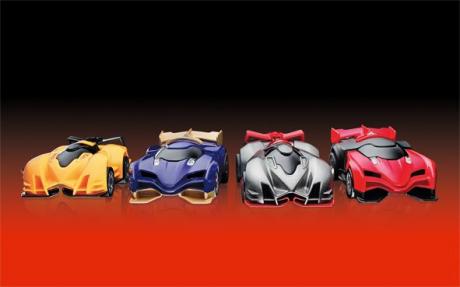
Ny legetøjsbil inkluderer innovative teknologier
Anki Drive er navnet på en helt ny kategori af legetøjs racerbiler, der positionerer sig som en blanding af et legetøj og et videospil (in english).
Nordic Semiconductor announces that San Francisco-based artificial intelligence (AI) consumer robotics startup, Anki Inc., has specified Nordic nRF8001 Connectivity chips to provide the Bluetooth Smart (previously called Bluetooth low energy) wireless connectivity in its Anki Drive iOS and Android controlled battle racing cars.Anki says that Anki Drive is an entirely new category of racing car-based toy positioned at the intersection of toy and video game. It comprises a large 8.5 x 3.5-ft (2.6 x 1.1m) roll-out vinyl mat printed with optical infra-red (IR) ink that the cars read to drive themselves. Anki Drive supports up to four cars that end users configure and control using their iOS or Android smartphones in order to battle with other cars (either other players or AI-controlled) using virtual weapons.
In operation, a Nordic Semiconductor nRF8001 Connectivity chip embedded into each car is used to communicate via Bluetooth Smart wireless technology with a free downloadable Anki Drive app running on the end user's smartphone. The app is used to control weapons and maneuvers (such as lane changes on each car during battle races), as well as to configure and upgrade weapons, difficulty level, and the abilities of cars in a 'virtual garage' using gaming points earned from successfully disabling other cars.
Anki also recently released a 'race' mode to complement its initial 'battle' mode gaming format, so users can choose between racing to a finish line first or seeing who can disable opponent cars most to earn points.
The cars themselves read a complex pattern of binary code embedded in IR ink into the middle layer of the vinyl race mat that reveals itself to an IR camera located on the undercarriage of each car when illuminated by an adjacent IR light source emitter.
To allow each car to precisely calculate its location, speed, and trajectory, and free users to focus on battle race tactics such as lane changing and using on-board weapons to disable other cars, the IR emitter track-to-camera-read-rate is around 500 updates per second.
- These cars are essentially fast racing robots that combine toy race cars with features so far only found in video games. They think, they know where they are at any point in time, they drive themselves, they are aware of other cars on the track, and like a chess game, they think many moves ahead in order to outsmart you, says Hanns Tappeiner, President and Co-Founder of Anki and adds:
- And the capabilities of the cars grow with the capabilities or skill level of the user - just like in modern video games. As players practice and get better over time, they can unlock further enhanced weapons and special features such as a Turbo Boost. Some of those items demand very high levels of acquired skill and keep players coming back to the game again and again.
Anki says it selected the Nordic Semiconductor nRF8001 because it needed components in its products that offered extreme levels of operational reliability, particularly on the RF side given the crowded nature of the 2.4GHz frequency band shared with Wi-Fi in most homes, and ultra-low power operation.
- Because this product is ultimately a toy designed for both children and young-at-heart adults, it has to be rock-solid robust and reliable and just work straight out-of-the-box regardless of operating environment, says Tappeiner.
- We also had to minimize power consumption throughout the product to maximize the runtime per charge from a single lithium polymer rechargeable battery embedded into each car. By selecting the right components and optimizing the software on the cars, we have been able to get between 20 and 25 minutes of playtime per charge, which is significantly longer than most toy cars of that scale. After that, cars are fully recharged in just 6-8 minutes.
Anki has also taken the unusual step (for an off-the-shelf consumer product) of making an Application Programing Interface (API) available to hobbyists, hackers, and third-party developers. Future releases of the API will even allow end-users to re-program and further develop the game themselves.
Tappeiner also says Anki Drive is just the first of a number of currently top secret AI robotics products under development within the company.
- Everyone imagines toys the way we see them in Pixar's Toy Story: smart, interactive, and fun. So far reality has been very different. But we are finally at a point where Robotics and AI can bridge that gap and make toys into what they really should be.
- The computer gaming industry has long understood that gamers love skill games where they get better with practice and rewarded with upgraded abilities and features, comments Geir Langeland, Nordic Semiconductor's Director of Sales & Marketing.
- So any game that successfully manages to transfer the feel of the best computer skill games with the added physical enjoyment of the best hardware games is something that I am sure consumers will really respond to and why I wouldn't be surprised if the Anki Drive were to make the top of a lot of Christmas and Birthday wish lists for some time to come.
- This product also demonstrates that with the advent of Bluetooth Smart wireless technology, toy developers are well positioned to leverage the power of modern smartphones to have a ready-made, computer-controlled wireless interface that supports the ability to merge computer games and physical toys in new ways that consumers will love, Geir Langeland concludes.
