

 Copyright: Yole
Markedet for chips til biler ser ind i store forandringer
Det gennemsnitlige antal chips i en bil vil stige fra 820 i 2024 til 1100 i 2027, estimerer analysefirmaet Yole, der forventer store forandringer i hele automotive chipforsyningskæden (in english).
The automotive semiconductor market is showing continuous growth, which is inevitable as the penetration of semiconductor-based applications, such as higher levels of ADAS and electrification, increases.
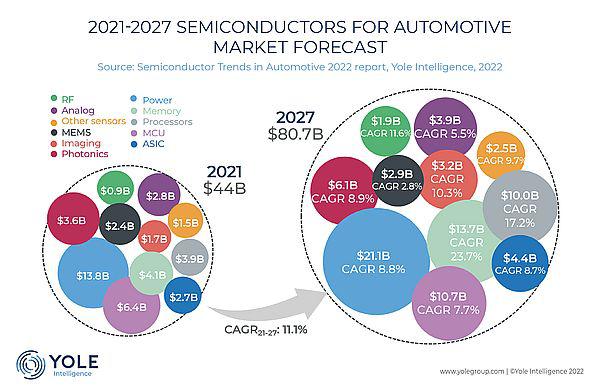
Despite a relatively flat light vehicle market, the market for semiconductor chips is expected to increase from US$44 billion in 2021 to US$80.7 billion in 2027 at a CAGR of 11.1%. This represents a semiconductor chip value of around US$550/car, growing to around US$912 in 2027. It is also an increase in the number of chips implemented in cars, from arround 820 chips today to around 1100 chips per car in 2027.
In this dynamic context, Yole Intelligence has developed a dedicated report to provide an in-depth understanding of the changing automotive industry ecosystem and supply chain. In its new 'Semiconductor Trends in Automotive 2022' report, the company, part of Yole Group, details the current and future internal and external factors affecting the durability of the car industry.
It also provides a complete overview of the current technology trends and market forecasts, including wafers, for cars. This study delivers key technical insights and analyses about future technology trends and challenges.
Pierrick Boulay Senior Technology & Market Analyst in the Photonics and Sensing Division at Yole Intelligence explains:
- The rapid increase in car electrification demands new types of substrates, such as SiC for power electronics. It is expected to represent 1,130 kwafers in 2027. While still low compared to the around 30,500 kwafers of Si expected for 2027, SiC will grow faster than Si and GaAs /Sapphire. ADAS is also an important driver, and MCU s with cutting-edge technology as low as 16 nm / 10 nm will go into ADAS, including radar and other sensor controls. Levels 4 and 5 of autonomy will drive increasing demand for more memory (DRAM) and computing power.
For electrification, vertical integration is becoming popular among OEMs. It can work out in multiple ways: full integration down to the component level, system integration and subcontracting build-to-print parts, strategic cooperation/direct investments with key component suppliers, etc.
Automotive supply chain needs to transform
The conventional automotive supply chain needs to examine its position thoroughly and transform through JVs, M&As, and new investments and divestments to retain its competitive edge, Yole points out. Although semiconductors are critical to the automotive industry in the ongoing disruptive transition, most players, both OEMs and T1 suppliers, do not have well-defined strategies for semiconductors yet. Specific expertise in semiconductor technologies and their supply chains, both internally and externally, is urgently needed to prepare for the future.
- Supply chain management will change as OEMs will need to negotiate directly with chip manufacturers, learn from the consumer industry, and keep ‘buffer stock’, says Eric Mounier, Ph.D., Director of Market Research at Yole Intelligence.
- They must work closer with chip manufacturers on volume forecasts and long-term orders. Just-in-time manufacturing, pioneered by Toyota in the 1960s, no longer works with chip manufacturers in the current geopolitical climate.
