

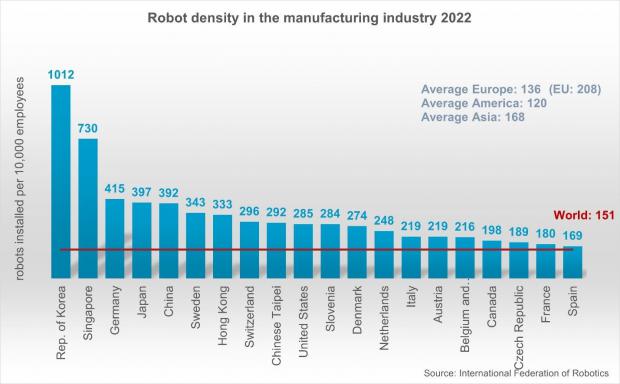
Korea, Singapore og Tyskland fører robotræset
Med godt 1000 robotter per 10.000 ansatte er Sydkorea klart i front, når det gælder automatisering ved hjælp af robotter. På næste pladser kommer Singapore (730 enheder) og Tyskland (415 enheder). Danmark ligger med 274 enheder pænt over EU-gennemsnittet.
Driven by the high volume of industrial robot installations, the world hit a new record of 3.9 million operational robots in 2022. The top most automated countries measured by robot density are: The Republic of Korea (1,012 robots per 10,000 employees), Singapore (730 units) and Germany (415 units). This is according to the World Robotics 2023 report, presented by the International Federation of Robotics (IFR).
Robot density is the number of operational industrial robots relative to the number of employees. It can cover the whole manufacturing industry or just specific industrial branches. The number of employees serves as a measure of economic size, so the quotient of operational stock over employees puts the operational stock on a uniform base.
- Robot density data reveal the state of automation worldwide and allow us to compare regions and countries, says Marina Bill, President of the International Federation of Robotics.
- The speed of robotics adoption in factories around the world is impressive: the new global average robot density hit an all-time high of 151 robots per 10,000 employees – more than double the number measured only six years ago.
Robot density by region
Asia has a robot density of 168 units per 10,000 employees in the manufacturing industry. On a global scale the economies of Korea, Singapore, Japan, Mainland China, Hong Kong and Chinese Taipei all rank within the top-ten most automated countries.
The European Union has a robot density of 208 units per 10,000 employees with Germany, Sweden and Switzerland ranking in the global top-ten group. North America´s robot density is 188 units per 10,000 employees. The United States is among the top-ten most automated countries in the manufacturing industry.
Top countries
The Republic of Korea is the world´s number one adopter of industrial robots. Robot density has increased by 6% on average each year since 2017.The Korean economy benefits from two large customers – a strong electronics industry and a distinct automotive industry.
Singapore follows with 730 robots per 10,000 employees. Singapore is a small country with a very low number of employees in the manufacturing industry.
Germany (415 robots per 10,000 employees) ranks third. Robot density of Europe´s biggest economy has grown by 5% CAGR since 2017.
Japan is in fourth place ( 397 units). Robot density of the world´s predominant robot manufacturing country grew by 7% on average each year (2017-2022).
China made its way up to fifth place 2021 and maintained this position in 2022. The country´s massive investment in automation technology yields a high robot density of 392 robots per 10,000 employees - despite a huge workforce of roughly 38 million people in the manufacturing industry.
Robot density in the United States rose from 274 units in 2021 to 285 in 2022. The country ranks tenth in the world.
A video is available: FACTS about Robots – the Global Automation Race in Numbers: https://www.youtube.com/watch?v=mtxMYJz4v2Y
About IFR
The International Federation of Robotics is the voice of the global robotics industry. IFR represents national robot associations, academia, and manufacturers of industrial and service robots from over twenty countries: www.ifr.org
The IFR Statistical Department provides data for two annual robotics studies:
World Robotics - Industrial Robots: This unique report provides global statistics on industrial robots in standardized tables and enables national comparisons to be made. It presents statistical data for around 40 countries broken down into areas of application, customer industries, types of robots and other technical and economic aspects. Production, export and import data is listed for selected countries. It also offers robot density, i.e. the number of robots per 10,000 employees, as a measure for the degree of automation.
World Robotics - Service Robots: This unique report describes marketable products, tasks, challenges and new developments by service robots application. The report includes the results of the annual IFR service robot survey on global sales of professional and consumer service robots and an industry structure analysis including a full list of all service robot producers known to the IFR. The study is jointly prepared with the robotics experts of Fraunhofer IPA, Stuttgart.
Boilerplate
