

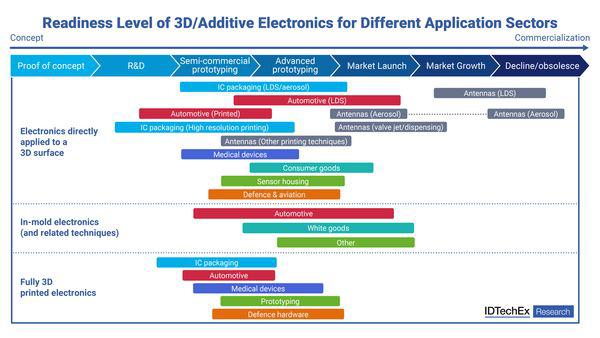
 In the report, IDTechEx assesses many different manufacturing technologies that are at different points of maturity and which can be used to create 3D electronics.
3D elektronik åbner mulighed for større produktdifferentiation
I ny rapport analyserer IDTechEx de mange forskellige produktionsteknologier (og deres respektive 'modensgrad'), der kan bruges i forbindelse med opbygning af 3D elektronik. Den 28. januar afholder analysefirmaet et gratis webinar om emnet.
Electronic capability has improved in every way, bar one: the form factor of electronics today still mostly consists of components on circuit boards packaged in a box.
The race to faster, smaller and more capable devices leaves an open opportunity for product designers: matching the human machine interfaces of electronics to the real world, whether 3D, flexible or stretchable.
3D electronics is ironically a relatively old 'embryonic' technology. The IDTechEx report "3D Electronics/Additive Electronics 2024-2034: Technologies, Players, and Markets" forecasts the opportunity being US$4.3 Billion in 2034, from a humble start of 3D printed antennas and capacitive touch switches.
In the report, IDTechEx assesses many different manufacturing technologies that are at different points of maturity and which can be used to create 3D electronics.
One such technology is In-mold electronics (IME), where conductive traces are printed and components mounted prior to thermoforming the flat substrate into a 3D part.
The IME manufacturing process can be regarded as an extension of the well-established in-mold decorating (IMD) process, in which thermoforming plastic with a decorative coating is converted to a 3D component via injection molding. Since IME is an evolution of an existing technique, much of the existing process knowledge and equipment can reused, although there is a reasonable learning curve.
IME outlook
Based on interviews with leading IME developers the IDTechEx report describes, that IME is still a few years away from widespread adoption, but the manufacturing ecosystem is largely in place. The next few years will be a moment of truth for the commercialization of the technology.
In January 2025 there are still only a handful of commercial product examples (such as a smoke/CO detector, smart lock, and controls on an industrial oven) that companies are willing to discuss publicly.
IME is being commercialized in a few consumer and industrial products ahead of what is anticipated to be the bigger mid-term opportunity: IME adoption in the automotive sector.
IME sees the light?
The initial focus was on IME parts to replace mechanical switches with capacitive switches, particularly for automotive (dashboard switches). However, this came at a time where discrete switches in cars were being transitioned by a number of car makers to controls via touch screen displays instead.
The past few years has seen a ramp-up of activity for IME with embedded lighting for interior lighting in vehicles. The main benefits that appeal to the automotive sector is the physical volume reduction and weight reduction, with one company interviewed by IDTechEx citing that they found that the thinnest they could achieve the functionality with conventional parts was 28mm, but with IME they could reduce that to just 8mm.
Further, unlike edge-lit diffused LED lighting panels, IME parts with embedded lighting do not have a bezel because the LEDs can be positioned closer to the light output, and therefore the LED count can be reduced. This means that the panel also requires less power while still meeting the application requirements.
According to companies which IDTechEx interviewed for the report, IME is currently being assessed for a number of automotive applications, and if successful these may see adoption around 2027/2028.
Based on the latest forecast model by IDTechEx, which has tracked the sector for over six years, the IME market (a subset of 3D electronics), is expected to have a value of US$974 million in 2035.
An opportunity unrecognized by product designers?
3D electronics could enable an exceptional point of differentiation, if only it was seen as such rather than the competitive focus usually being on what is behind the surface, not on it. It's an open opportunity for a product designer to take the lead.
To find out more about this IDTechEx report, including downloadable sample pages, please visit www.IDTechEx.com/3DElec.
For the full portfolio of 3D printing market research available from IDTechEx, please see www.IDTechEx.com/Research/3D.
Upcoming free-to-attend webinar
IDTechEx will be hosting a free-to-attend webinar on the topic on Tuesday 28 January 2025 - In-Mold Electronics: The Moment of Truth.
This webinar will include:
- The opportunity for 3D Electronics
- What is In-mold Electronics
- Commercial progress of In-Mold Electronics
- 10 year outlook
The exactly same webinar will be held tree times in one day. Please click here to register for the session most convenient for you.
If you are unable to make the date, please register anyway to receive the links to the on-demand recording (available for a limited time) and webinar slides as soon as they are available.
