

Imaging-system til simultan opsamling af farve og 'near-infrared' billeder
Forskere på Tokyo Institute of Technology og kollegaer hos Olympus står et image-system, der simultant kan opsamle farve og 'near-infrared' billeder (in english).
Masatoshi Okutomi and colleagues at Tokyo Institute of Technology and Olympus R&D have developed a new imaging system for simultaneous acquisition of color (RGB) and near-infrared (NIR) images using only a single image sensor.Commercially available compact and low-cost color digital cameras acquire single-sensor color images with a color filter array (CFA)— an array of R, G, and B filters and overlaid on the image sensor. Therefore, the data acquired by CFA based image sensors are mosaic. A set of image processing algorithms such as an interpolation process of the mosaic data called demosaicking, and color correction is performed to acquire a full-color image. In this way, current color cameras realize low-cost and easy-to-use color image acquisition.
In recent years, many applications using a pair of color (RGB) and near-infrared (NIR) images have been proposed by computer vision and image processing communities. With this background, the group of Masatoshi Okutomi at Tokyo Institute of Technology and researchers at Olympus R&D have developed a prototype of a new imaging system for the simultaneous acquisition of RGB and NIR images using a single image sensor.
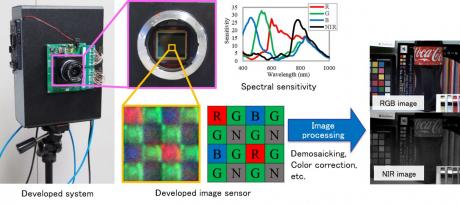
Figure 1 shows an overview of a prototype of this system consisting of a novel CFA that contains both RGB and NIR filters. The arrangement of the new CFA is shown in the Fig. 1, where 'N' represents the NIR filter.
The researchers have also developed an image processing system that can execute sets of image processing algorithms, such as demosaicking and color correction, in real time. The new system can acquire and display high-quality RGB and NIR images simultaneously at 60 frames per second (fps). Since the new system can provide users with a practical solution for simultaneously acquiring both the RGB and the NIR images, it is expected to open up a new range of applications in many fields such as remote sensing, security, robotics, agriculture, and medical imaging, where the NIR information is useful.
