

Højtydende audio A/D konvertere
Texas Instruments (TI) tilbyder nye multikanal audio A/D konvertere, der gør det lettere at designe audio frontend designs (in english).
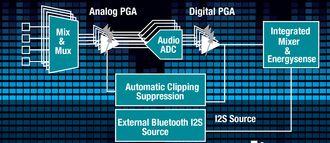
Texas Instruments (TI) introduces a family of six high-performance audio analog-to-digital converters (ADCs). Featuring a dynamic range as high as 110 dB, the devices in the PCM1865 family integrate features typically found in portable audio codecs, while also giving designers a level of performance previously found only in single-function, professional audio ADCs.Powered by a single 3.3-V supply, the PCM1865 audio ADC removes the traditional requirement for a dedicated analog 5-V rail, making smaller, more efficient products possible. Each device in the new family solves many system-level design headaches, including hum and ground noise, input-signal level sensitivity, and attenuation, all with a single device.
This integration is particularly beneficial for end equipment like personal computers; sound bars; audio docks; Bluetooth speakers; video-security systems; and automotive infotainment equipment including after-market head units, amplifiers and active noise-cancellation systems.
Key benefits of the PCM1865 family:
Design flexibility: The PCM1865 family consists of six pin-to-pin compatible devices offering two- and four-channel options, with software- and hardware-controlled variants.
High dynamic range: Three of the six devices in the PCM1865 family can achieve up to 110-dB performance. No other audio ADCs on the market can achieve a performance level of 110 dB with a single 3.3-V power supply.
Improves signal-to-noise ratio (SNR): With direct, high-voltage 2.1-VRMS support, the devices optimize audio quality and allow for a higher SNR. Additionally, the software-controlled devices’ automatic clipping-suppression feature helps designers optimize input sensitivity for maximum SNR.
Reduces system complexity: The new audio ADCs can deliver the same performance as competing solutions while potentially eliminating as many as 20 components. The devices integrate a clock-generating phase-lockedloop (PLL), programmable gain amplifier and universal front end, which supports various inputs from low-level microphones to 4.2-VRMS differential inputs. Designers can easily configure single-ended and differential inputs to cancel hum and ground noise.
Helps meet mandated low-power standby requirements: The integration of TI’s patent-pending Energysense technology helps designers meet operating requirements set by the European Union’s (EU) Ecodesign Directive. By using the on-chip secondary ADC, designers can easily set both sleep and wake-up thresholds, which can help equipment achieve the energy efficiency levels required in this EU directive.
Small size for space-constrained applications: Available in 7.8-mm by 4.4-mm TSSOP packages, the devices are up to 45 percent smaller than competing devices.
