

Højhastigheds D/A konverter med ekseptionel spektral renhed
Linear Technology lancerer 16-bit, 2,5Gsps D/A konverter (DAC), der opererer med 74dB spurious free dynamikområde (in english).
Modern high-speed wired and wireless communications schemes need to make an efficient use of the limited available bandwidth. Generating broadband signals that take full advantage of the bandwidth has always been a challenge. This is mainly due to limitations in the bandwidth, linearity and spurious performance of the high-speed digital to analog converter (DAC) used to produce these signals.Besides communications, applications such as instrumentation, radar and automatic test equipment (ATE) ask for the generation of signals with high spectral purity, precision and accuracy. The DAC is usually the bottleneck in meeting the strict requirements in such applications.
Linear Technology’s new LTC2000, a 16-bit 2.5Gsps DAC, offers a relief to the designers working on solutions for all these applications by offering unprecedented spurious performance, over 1GHz bandwidth, very high linearity, and excellent accuracy.
Spurious performance
The spurious performance of a high-speed DAC is assessed through its spurious free dynamic range (SFDR). Spurious signals are undesired signals that appear at the output of the DAC. Simply stated, the fewer and lower the spurs are, the better the DAC is.
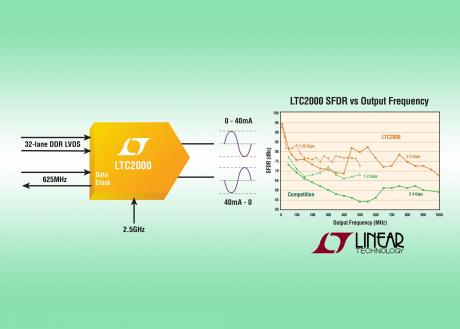
The LTC2000’s output has exceptionally low spurious products. With 74dBc SFDR at 200MHz output, the LTC2000 ranks first among all high-speed DACs in this respect. Furthermore, and unlike other high-speed DACs whose SFDR drops quickly beyond 100 or 200MHz output, the LTC2000 maintains its excellent performance and delivers an unrivaled SFDR of 68dBc at 1GHz output.
Linearity
One reliable metric to quantify DAC linearity at high frequencies is the 2-tone intermodulation distortion (2-tone IMD) test. This is a taxing evaluation, where two nearby tones are generated by the DAC to assess the level of impurities (distortion products) the DAC produces along with the requested tones.
The results correlate well with real-world DAC applications where multiple communications channels are generated simultaneously. The existence of such distortion products at the DAC output causes interference between the channels, and limits the ability to utilize the available bandwidth error-free.
The LTC2000 maintains a world-class performance of better than 78dBc 2-tone IMD up to 1GHz analog output. This makes the LTC2000 ideal for demanding applications where multiple channels can be produced with negligible inter-channel interference.
With a state-of-the-art linearity performance, the LTC2000 can synthesize broadband baseband or low-IF signals without the need for extra linearization circuitry and the software that comes with it. This simplifies the design process and lowers the total system cost and risk.
Bandwidth
The LTC2000 accepts input data at the rate of 2.5 billion words a second at its full resolution of 16 bits. This rate allows the generation of signals over a bandwidth of 1GHz.
Accuracy Besides having ultrahigh linearity to synthesize fast signals, the LTC2000 has superior low frequency performance as defined by its low integral nonlinearity error (INL). This is essential for test and measurement and other high-end applications. The LTC2000 also offers very low offset and gain errors.
Spectral Purity
The output of the DAC gets corrupted by many of the DAC’s nonidealities that make its output spectrum not as pure as desired. To maintain a high level of spectral purity, the linearity and SFDR of the DAC must be high. The LTC2000 has these comfortably covered.
Another DAC nonideality that is often not specified by DAC vendors is its additive phase noise. The DAC’s additive phase noise causes adjacent channel interference and limits the number of channels and the spacing between them. This specifically applies to communications systems. Test and measurement, radar and ATE applications often have the need to be able to decipher close-in signals. Maintaining low phase noise is essential in meetings this requirement.
The LTC2000 was uniquely designed for exceptionally low additive phase noise and the explicit results of this measurement taken with the LTC2000 is shown in the datasheet. The combination of LTC2000’s linearity, SFDR and additive phase noise performances results in an outstanding spectral purity suited as a solution for the most demanding applications.
Other benefits of the LTC2000
The LTC2000 incorporates a single or dual port interface to load data into it, and offers flexibility in the type of the incoming digital signal. It accepts DHSTL to keep the power consumption low, and DDR LVDS to talk to FPGAs that do not support DHSTL signaling.
The LTC2000’s substantial analog output current of 40mA nominal allows its use with different load impedance values, saving the system designer the need to apply a significant amount of gain. The LTC2000 represents a family of pin- and software-compatible 16-, 14- and 11-bit DACs.
Demoboards and samples are available via the Linear Technology website www.linear.com/product/LTC2000
