

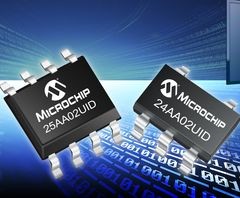
EEPROM'er er forsynet med unik ID-nummer
Microchip lancerer familie af serielle EEPROM'er, der er forsynet med et unikt, forprogrammeret 32-bit serienummer (in english).
Microchip announces the introduction of a family of serial EEPROM devices that feature a unique, pre-programmed 32-bit serial number for customers requiring unique IDs in their applications. For applications needing longer than 32-bit IDs, the unique ID can be extended to 48-bit, 64-bit, 96-bit, 128-bit and other lengths by increasing the number of bytes read from memory.
Because the 32-bit ID is unique within these devices, any longer bit sequence is also unique. These 2 Kb serial EEPROM devices are available in standard busses, such as I2C, SPI and Microwire, and integrate up to 1.5 Kb of memory that can be used as a standard EEPROM.
In addition, Microchip has released a 256 Kb I2C unique-ID device, which, in addition to the 32-bit serial number, also contains the IEEE EUI-48 and IEEE EUI-64 MAC addresses. These IDs are in a write-protected area of the memory, giving users up to 224 Kb of EEPROM to use in their applications. Microchip ensures this 32-bit ID is unique across the entire family of 24AA02UID, 24AA025UID, 11AA02UID, 25AA02UID and 24AA256UID unique-ID EEPROM devices.
Microchip has also added to its existing EUI-48 MAC-address portfolio by introducing a family with pre-programmed EUI-64 MAC addresses. These 2 Kb EEPROM devices are available in the I2C,SPI and UNI/O busses, which provide easy and inexpensive access to MAC addresses, and feature up to 1.5 Kb of EEPROM which can be used for storing configuration settings, or as a scratch-pad area for buffering small amounts of data.
The 24AA02E64, 24AA025E64, 11AA02E64 and 25AA02E64 serial EEPROM devices have a built-in 64-bit Extended Unique Identifier (EUI) that is needed to identify the network hardware’s physical address. These built-in MAC addresses enable designers to buy addresses only when needed, and also eliminate the need for serialisation and programming.
The EUI-64 networking applications for the new EEPROMs are best suited for those involving Ethernet, Wi-Fi, Bluetooth, FireWire, ZigBee and Microchip’s MiWi protocol. These devices excel in a broad range of applications, including those in the consumer sector, such as wireless radios and printers, Bluetooth headsets, Internet-enabled LCD TVs and home automation; and industrial market such as Ethernet, USB and industrial automation.
The applications for the new unique-ID devices include those in the consumer, medical, industrial, automotive and networking markets. Examples of ideal end-applications include printers, handheld devices, remote sensor modules, audio headsets, device authentication and identification for medical devices, wireless products and battery-operated products. The unique ID devices offer customers an easy, low-cost, plug-and-play solution for adding a serial number or unique ID into an application.
