

Apple's Arm-baserede M1-chip skaber chokbølger
Apple introducerede i november sidste år de første produkter med deres egenudviklede Arm-baserede SoC. Brancheanalytikere vurderer, at introduktionen for alvor kan sætte fart på markedet for high-end ARM-baserede pc'er (in english).
Last November Apples released its first ARM-based SoC, called M1. M1 has been designed by Apple, as a CPU for its line of Macintosh product, and Apple claims that the M1 SoC is the world’s fastest CPU with the best CPU performance per watt.- Two new Apple MacBook models and the Mac mini are now powered by an Apple in-house SoC design. The transition from Intel x86 processors has created shockwaves felt throughout the processor and computing world. This new, first SoC for Mac features 4-CPU high-performance cores, 4-CPU high-efficiency cores, and 8-GPU cores, explains Belinda Dube, Technology & Cost Analyst, Memories at System Plus Consulting.
The tight software-hardware integration inside Apple enabled a compact, efficient processor for personal computer that outcompetes many premium microprocessors. 16 billion transistors using TSMC 5nm process were used to build it. The chip architecture provides optimized power efficiency.
John Lorenz, Technology & Market Analyst, Processors at Yole Développement (Yole) comments:
- By switching to the M1 processor, Apple gives a boost to the prospects of ARM-based PCs, previously the domain of low-performing Chromebooks. Not only is this a well-spec’d solution for Apple, this is likely saving some cost on the MacBook’s components. Other notebook OEMs are sure to take note and may further examine their x86-based solutions, although Apple can do more coordination between hardware and software as they control their operating system. Most Windows-based OEMs would not have that luxury.
System Plus Consulting, the reverse engineering and costing company has announced a dedicated analysis focused on the latest Apple’s innovation. This report is titled: Apple M1 System-on-Chip.
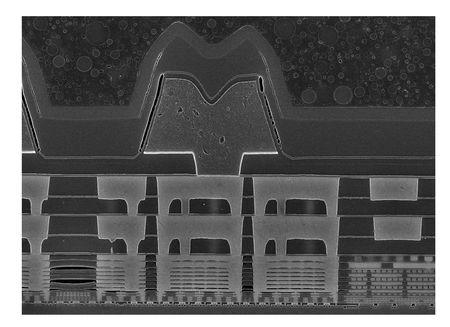
To reveal all the details of Apple M1, System Plus Consulting’ report features multiple analyses: a floor plan analysis to understand the high-level chip architecture with IP block area contribution measurements, a front-end construction analysis that reveals the most interesting features of the new TSMC 5nm process, a back-end construction analysis of the packaging structure, and a detailed manufacturing cost analysis.
- On the SoC side, it appears that the die area of the M1 was optimized for functionality rather than SRAM cache, says Belinda Dube.
According to the Apple M1 report, there is limited on-chip cache, taking cues from mobile SoC designs relying on the UMA concept and external LPDDR4X DRAM. Significant die area is devoted to standard cell functions, indicating that Apple is leveraging in-house chip design to optimize hardware for the operating system.
On the packaging side, the same structure is used for Apple’s A12X and A12Z, with the integration of the DRAM on the SoC substrate, and embedded silicon capacitors in the substrate.
Don Scansen collaborates with System Plus Consulting’s team to analyze Apple’s M1:
- The first product from Apple’s chip design team meant for the personal computer line surpassed many competing microprocessors and nearly everything currently in other Apple products, particularly in single core and GPU tests, he says.
For the EETIMES webplatform, Don Scansen har written an article about the new M1 SoC.
Read it here.
