

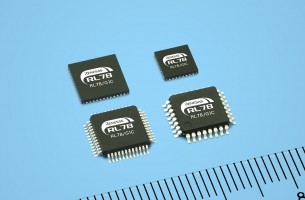
16-bit MCU med USB-lader
Renesas lancerer industriens første low-power 16-bit MCU med integreret USB, der åbner mulighed for højhastigheds ladning (in english).
Renesas Electronics hsa announced the release of the RL78/G1C Group of microcontrollers (MCUs), which are the industry's first 16-bit MCUs that conform to the USB Battery Charging Specification, Revision 1.2 and provide USB host/function interfaces.
The battery charging function of the new RL78/G1Cconforms to the USB BC 1.2 standard, which enables high speed charging up to 1.5 A. Furthermore, by adopting the RL78 core, which features the lowest power consumption class in the industry, power consumption during USB operation is reduced by about 60% [Note 1].
The USB interface is not only used between PCs and PC peripheral equipment, but is also used as a convenient general-purpose interface for consumer and industrial equipment in a wide range of areas such as smartphone accessories, portable healthcare devices, AV accessories, game equipment and industrial equipment.
Recently, the needs for charging from a USB terminal have been increasing. However, USB ports as defined in the earlier USB 2.0 standard could not use currents in excess of 500 mA and, as a result, cannot support high-speed charging. Thus support for the USB BC 1.2 standard, which allows currents of up to 1.5 A to be used, is strongly desired.
The first series within the RL78/G1C Group of MCUs will feature 32 to 48-pin devices in packages down to 5 x 5mm, and up to 32KB of flash and 5.5KB of on board RAM. The RL78/G1C also integrates a 1% accurate high-speed oscillator.
Renesas is moving forward aggressively with the new RL78 series product deployments. At the same time as being able to contribute to lower power consumption in end products, with the new RL78/G1C Group of MCUs, Renesas now provides an extensive lineup that supports the addition of products that include USB battery charging functionality.
Samples of the RL78/G1C Group of MCUs are available now. Mass production of the RL78/G1C devices is scheduled to begin in March 2013 and is expected to reach a scale of 1,000,000 units per month in March 2014.
